Key Takeaways
- To use FIFO when restocking food, pull the existing product to the front, put the new stock behind it, and check dates as you go. The oldest unit is always the one a shopper reaches first.
- FIFO rarely fails because staff don’t understand it. It fails because on a front-loaded shelf, doing it wrong is faster than doing it right.
- Poor rotation adds up. US retail generated 4.63 million tons of surplus food in 2024, worth $30.3 billion, about 3 percent of food and beverage retail sales (ReFED, 2024 data).
- The FDA Food Code doesn’t mention FIFO by name. It does require date marking on certain ready-to-eat foods prepared in store, with a limit of 7 days at 41°F or colder.
- The lasting fix is mechanical. Load from the back, let the shelf present the oldest unit, and keep lanes separate. A short daily date check covers what the shelf can’t.
You find it on a Tuesday afternoon. A half-gallon of milk, two days past its date, was sitting at the back of the door, behind a full row of fresh ones.
Nobody decided to sell old milk. Everyone on the team knows the rule. The milk ended up at the back because the shelf made that the easiest place for it to go.
That’s the real story of stock rotation in most stores. The principle is simple. Keeping to it on a busy shift, one delivery after another, is the hard part.
How to use the FIFO method to restock food
FIFO stands for first in, first out. The product that arrives first gets sold first.
When you restock, that means four things, in this order.
- Pull what’s already there to the front. Every unit on the shelf moves forward to the edge.
- Check the dates. Anything short-dated goes to the very front, and anything past its date comes off the shelf.
- Load the new stock behind it. New products always go to the back of the lane.
- Face the front row. Labels out, rows straight, so the oldest unit is the obvious one to take.
That’s the whole method. The oldest product is always the one a shopper reaches first, and nothing new ever hides it.
Why is rotation harder on a sales floor than in a stockroom?
Most stock rotation advice comes from warehouses, and warehouses are controlled environments. Pickers take from a set location, and nobody reaches past the front of a pallet.
A store shelf gets none of that control.
Customers reach the back. Plenty of shoppers dig for the freshest date, especially on milk, bread, and packaged salads. Every time they do, the newest unit leaves first, and the oldest stays.
Restocking happens while the store is open. The average US convenience store handled 45,160 transactions a month in 2025, about 1,484 a day (NACS). There’s rarely a quiet hour to empty a lane and reload it properly.
Deliveries don’t always arrive in date order. A newer delivery can carry an earlier date than stock already on the shelf. Rotating by arrival alone gets that wrong.
Why FIFO breaks on static shelves
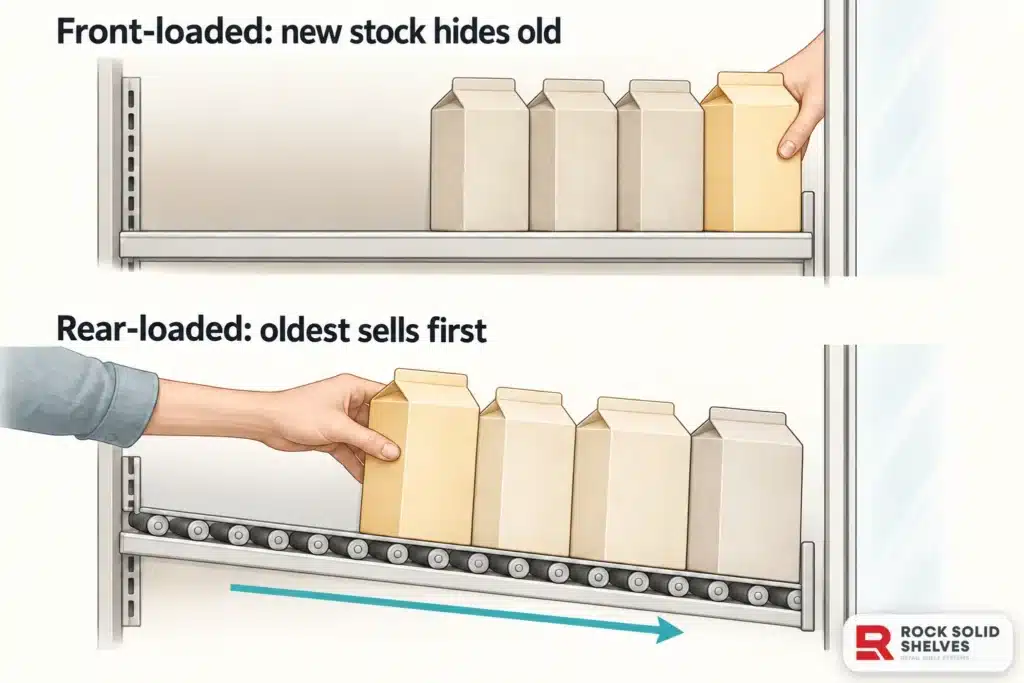
On a flat, front-loaded shelf, FIFO means taking every unit out of the lane, loading new stock at the back, and putting older units back in front.
Now picture doing that for twelve lanes of dairy with a line at the register. The quick version is to slide the new stock in at the front and move on. Nobody chooses to break the rule. The shelf charges a time penalty for keeping it.
Repeat that for a few weeks, and the lane sorts itself backward. The freshest product sits at the front where it sells first, and the oldest drifts to the back until someone finds it expired.
What poor rotation costs
Some of the costs are easy to see. A product that expires on the shelf gets thrown out, and you paid for it.
Across the whole US retail sector, ReFED estimates 4.63 million tons of surplus food in 2024. That’s worth $30.3 billion, about 3 percent of food and beverage retail sales. Dairy and eggs alone accounted for 339,000 tons, and that’s the category most convenience stores carry in their coolers.
Not all of that comes down to rotation. Overordering, damage, and slow sellers also play a part. But rotation is the piece a store controls every single day.
The other cost is harder to count. A customer who gets home with expired milk doesn’t think “rotation problem.” They think the store can’t be trusted with fresh products, and some of them stop buying them there.
FIFO or FEFO?
FEFO stands for first expired, first out. Instead of rotating by when the stock arrived, you rotate by the package date.
For most packaged goods in a convenience store, the two give the same answer, because older deliveries usually carry earlier dates. When they don’t, the date wins. A delivery that came in today with an earlier date goes in front of the stock that arrived last week.
The simplest rule for staff covers both: check the date, not the delivery.
What the food code actually requires
People often assume FIFO is a legal requirement. It isn’t named in the FDA Food Code.
What the Food Code does require is date marking. Under section 3-501.17, ready-to-eat, time/temperature control for safety food that’s prepared in the store and held longer than 24 hours must be marked with the date or day by which it must be consumed, sold, or discarded. It can be held for up to 7 days at 41°F (5°C) or colder.
The FDA doesn’t dictate a label format. Calendar dates, days of the week, and color codes all work, as long as the system is clear.
States adopt the Food Code on their own schedules and sometimes with changes, so your local health department has the final word. The practical takeaway is this. Date marking tells you when something has to go. Rotation makes sure it sells before then.
Making rotation happen automatically
If the problem is that the right way takes longer, the fix is to make the right way the only way.
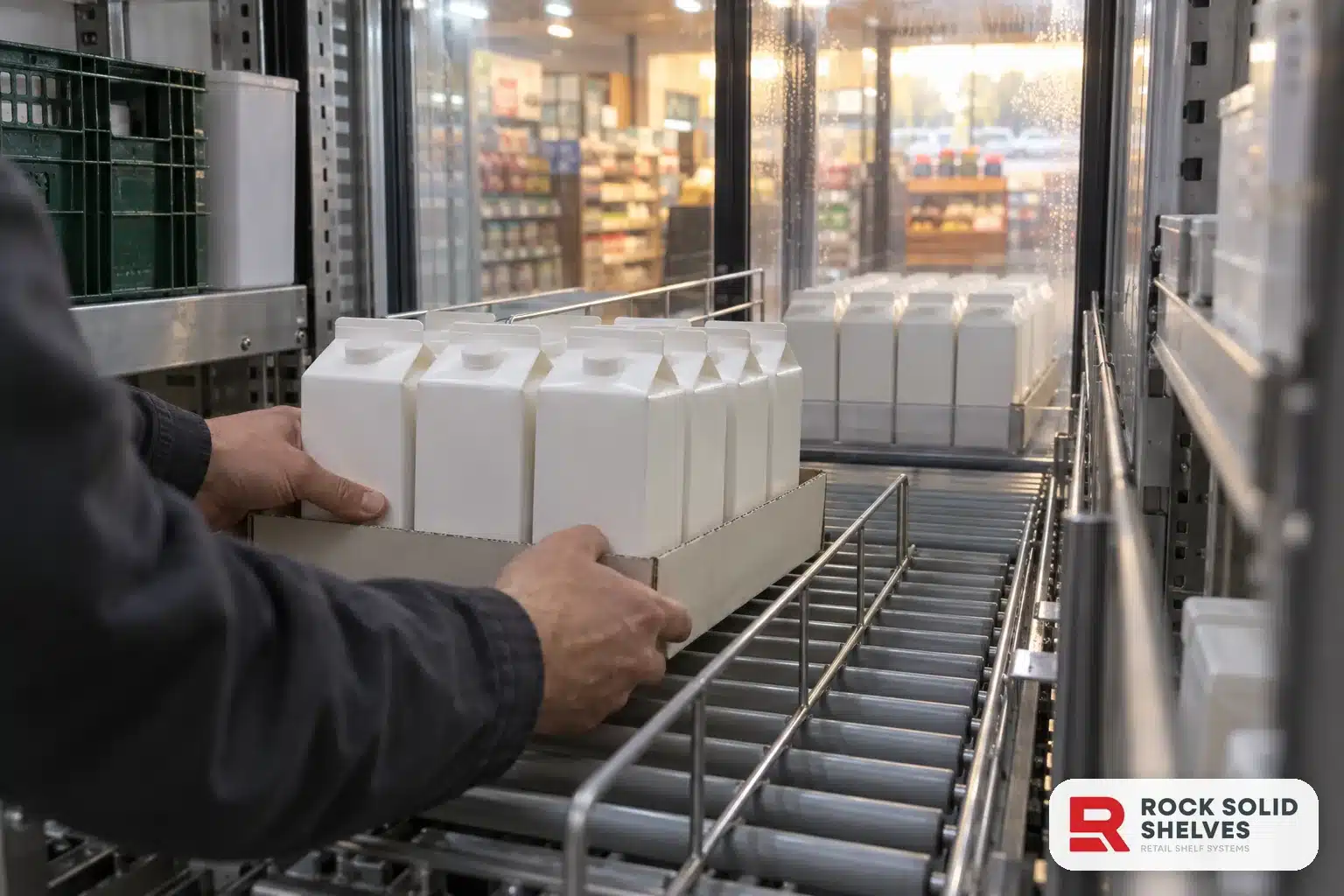
Load from the back. In a walk-in cooler, staff can restock from inside the box, behind the shelves. New stock physically goes in behind the old, with no emptying and reloading.
Let gravity present the oldest unit. On a sloped gravity-feed shelf, the product loaded at the back rolls or slides forward as units sell. The front of the lane always holds whatever went in first. Rotation happens because the shelf only allows one order.
Keep lanes separate. Wire dividers stop units from drifting between lanes. That matters more than it sounds, because two lanes of the same product with different dates will blur together without them.
Know what pushers do and don’t do. On flat shelves, spring pushers keep the front row facing. That’s valuable. But most are front-loading, so they don’t rotate stock on their own. Loading order still depends on the person doing it.
There’s more on how gravity-feed and pushers work and where each belongs in our guides to glides versus roller shelves and to shelf pushers.
A rotation routine for what the shelf can’t solve
A good shelf fixes the loading order. It won’t check dates, and it can’t see a delivery that arrived short-dated. A short routine covers the rest.
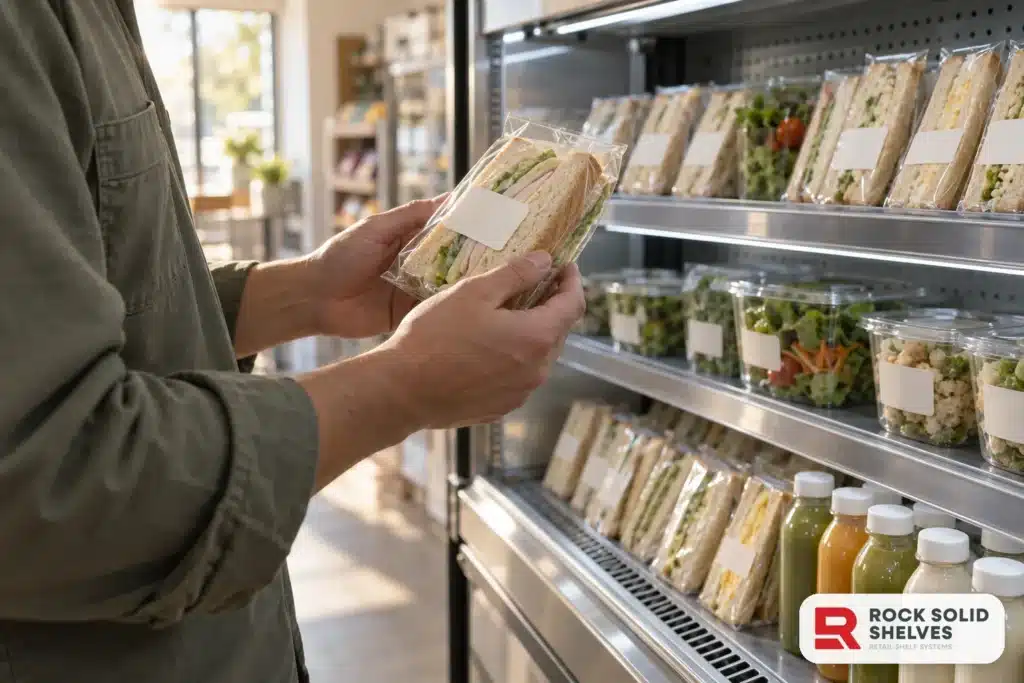
- Check the shortest-dated categories every day. Prepared sandwiches and salads first, then dairy, then bakery. Anything else can go on a weekly cycle.
- Compare deliveries to the shelf before loading. If the new stock carries an earlier date than what’s out, it goes in front, not behind.
- Pull or mark down early. Decide how many days before the date you act, and stick to it.
- Give each section an owner. “Everyone checks dates” usually means nobody does.
- Keep a simple log of what gets pulled. A week of notes shows which lanes continue to cause waste. That’s usually where to start converting shelves.
The short version
FIFO means the oldest product sells first. When restocking, pull existing stock forward, check dates, load new stock behind, and face the front row.
It breaks in stores for mechanical reasons. On a front-loaded static shelf, the right way takes longer than the wrong way, so under time pressure, new stock goes in front and old stock drifts back until it expires.
The lasting fix is to make correct loading the default. Load from the back, let a sloped gravity-feed shelf present the oldest unit, and keep lanes separate. Add a short daily date check on the shortest-dated categories, and rotation stops depending on how busy the shift is.
Frequently asked questions
How do we use the FIFO method to restock food?
Move the product already on the shelf to the front, check its dates, then place the new stock behind it. Anything close to its date goes to the very front, and anything past its date comes off. The goal is for the oldest unit always to be the first one a customer takes.
What’s the difference between FIFO and FEFO?
FIFO rotates stock based on its arrival. FEFO (first expired, first out) rotates it by the packaging date. They usually agree, but when a newer delivery carries an earlier date, FEFO puts it in front. For perishables, rotating by the date is the safer rule.
Do grocery stores use FIFO or LIFO?
On the shelf, grocery and convenience stores rotate stock first-in, first-out or by expiration date. LIFO, last in, first out, mostly comes up in accounting, where it’s a way of valuing inventory rather than stocking shelves.
What is the golden rule of stock rotation?
Check the date, not the delivery. The unit with the earliest date goes to the front, and new stock goes behind it.
How often should you rotate stock in a convenience store?
Every time you restock, rotation is part of loading rather than a separate job. On top of that, check the shortest-dated categories daily (prepared food, dairy, and bakery) and everything else weekly.