Key Takeaways
- Cooler glides and roller shelves are both gravity feed. Both need a shelf that slopes toward the door, and both bring the next unit forward when one sells.
- Glides are plastic tracks with no moving parts. Most are molded for a single pack size, so they’re simple and inexpensive for a door that only ever holds one format.
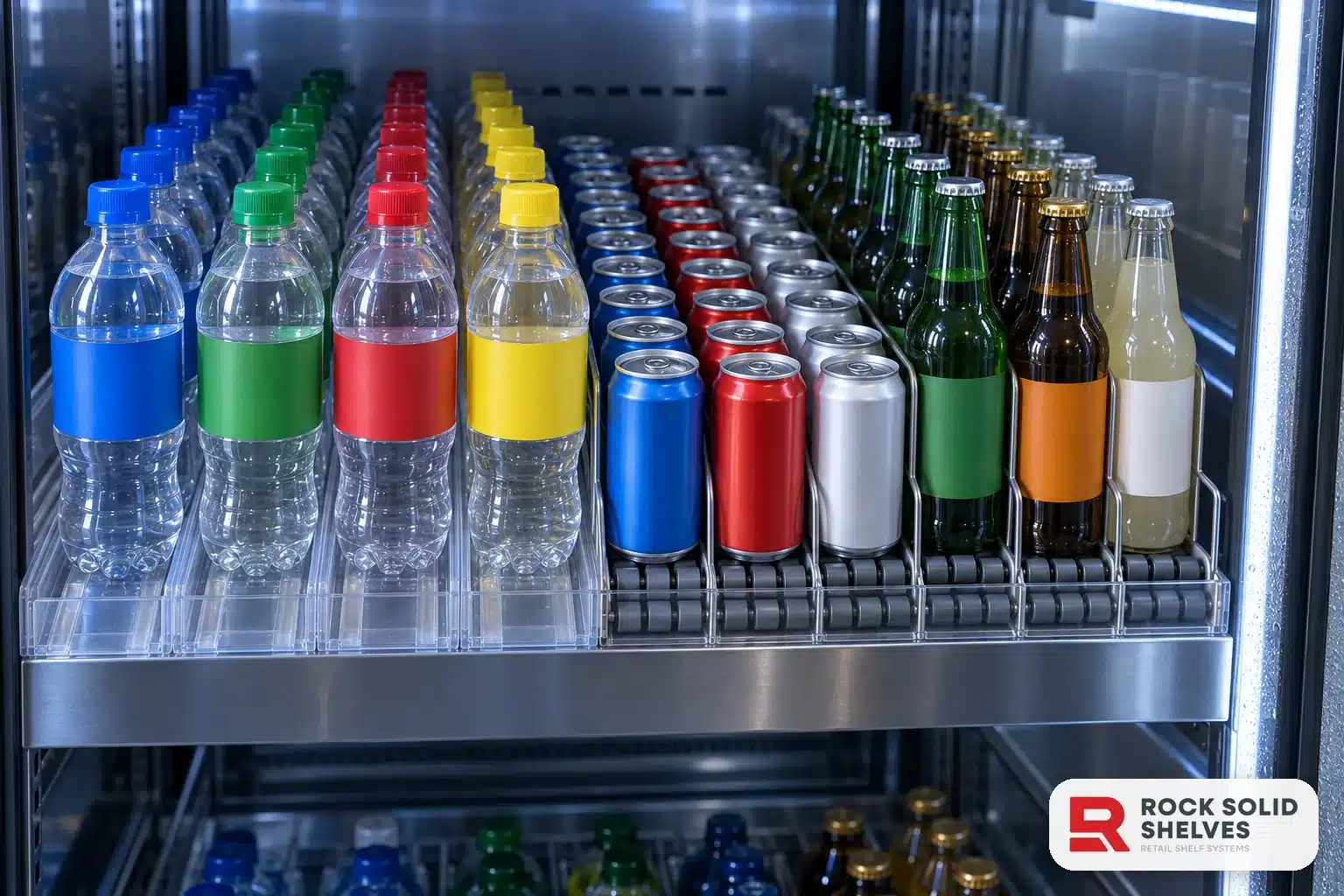
- Roller shelves carry product on a bed of rollers with adjustable lanes, so one shelf can hold cans, glass, cartons, and multipacks side by side.
- The biggest difference shows up at reset time. A fixed-size track has to be swapped when a pack changes. An adjustable lane just gets moved.
- Match the system to the door, not the store. Single-format doors that rarely change suit glides. Mixed, heavy, or frequently reset doors are suited to rollers.
Ask two suppliers to quote gravity-feed for your cooler doors, and you can get back two products that look nothing alike.
One sends clear plastic tracks that sit on the shelf, a row of bottles in each channel. The other sends a roller bed with wire dividers and a retainer across the front. Both promise the same result: take a bottle and the next one moves up, so the door looks full all day.
They’re both telling the truth. They get there differently, and that difference decides which one you’ll still be happy with a year from now.
Two ways to let gravity do the work
Both systems rely on the same thing: a shelf that slopes down toward the door. Take one unit off the front, and the row behind it moves down to fill the gap. There’s no spring and nothing to power.
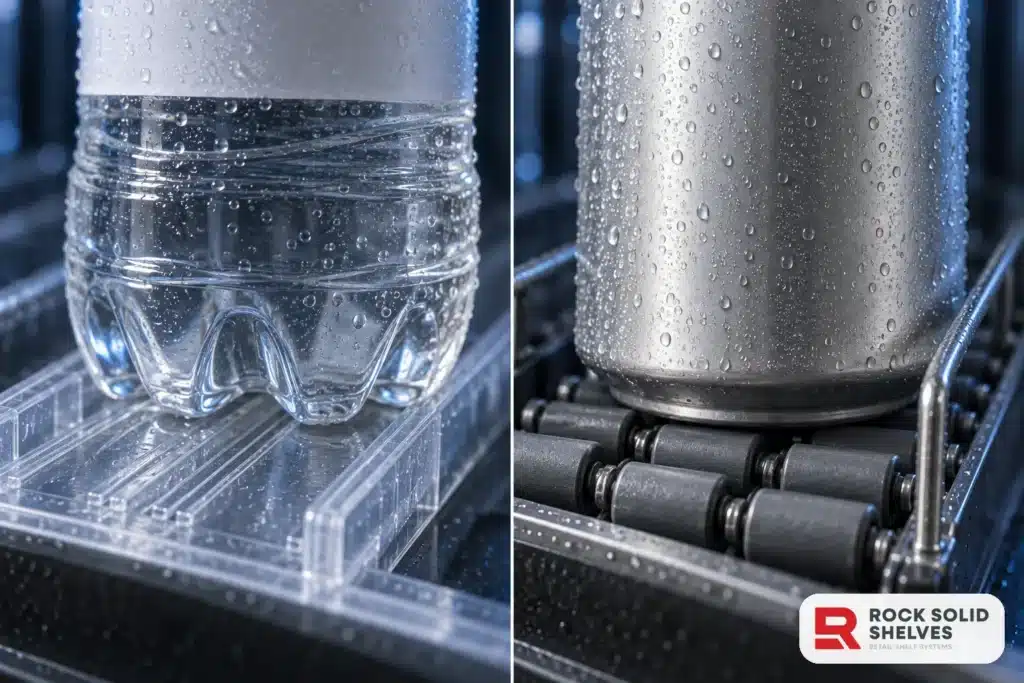
What changes is the surface the product rides on. A glide gives it a slick plastic channel to slide along. A roller shelf has a bed of small rollers to roll across.
Everything else in this comparison follows from that one difference.
How cooler glides work
A cooler glide is a molded plastic track. The common versions are polypropylene with a slip agent built into the material, so bottles slide rather than stick (that’s how Display Technologies describes Visi-Slide and how Siffron describes its Bevy-Glide). Each track is a set of channels, one row of product per channel, with a low stop ring at the front to hold the lead unit.
Glides need an angled shelf. Display Technologies is explicit that the system works “so long as the shelves are angled.” On a flat shelf, a glide is just a tray.
Most glides are sized to a pack. Visi-Slide is sold in separate versions for 8 oz, 12 oz slim, 12 to 16 oz, 20 to 24 oz, 32 oz, 1 liter, and 2 liter bottles, in widths from 1 to 10 lanes. A standard 16-oz track holds up to 10 bottles per channel.
Not every glide is fixed, to be fair. PFI’s range includes a fixed-width Cool Glide, an Intelli-Glide designed for mixed single-serve and multipacks on a single shelf, and a Modular Glide with adjustable floors and dividers. So “glides” covers more than one kind of product, and it’s worth asking which kind you’re being quoted.
How roller shelves work
A roller shelf replaces the channel with a bed of small rollers. The product sits on top and rolls forward as the unit in front is taken. Wire dividers set the lanes, and a clear retainer across the front stops the lead unit at the glass.
FlexRoller, the Bruegmann system, and Rock Solid Shelves are documented as fronting products at a minimum shelf angle of 6 degrees. It’s built to carry plastic, glass, aluminum, canned goods, boxed goods, Tetra Pak cartons, and shrink-wrapped multipacks on the same system. Front retainers come in different heights for short and tall packs, and lane widths adjust to the package rather than the package having to fit the lane.
Where glides make sense
Glides are at their best on a door that holds one format and stays that way.
A door of 20 oz bottles selling the same pack all year is exactly what a fixed-size track is designed for. Put the tracks on the angled shelf, load them, and you’re done. There’s very little to go wrong and very little to adjust.
They’re also easy to keep clean. With no moving parts, cleaning means lifting a track out and washing one piece of plastic.
And the entry cost per lane is low. That matters if you’re converting a few doors to find out whether gravity feed is worth it in your store at all.
Where roller shelves earn their cost
Rollers start to make more sense as soon as a door stops being uniform.
Most convenience store doors aren’t one format. Slim energy drink cans sit next to glass bottles, and a 12-pack sits next to both. A fixed-size glide can’t carry that mix on a single shelf without a separate track for each pack. Some packs don’t suit a bottle channel to begin with, like cartons and multipacks with flat bases.
A roller bed is far less fussy about shape. Cans, glass, cartons, and multipacks all roll, and the dividers move to fit each pack.

Heavier packs are the other thing to think about. Liter bottles and multipacks ask more of whatever surface they’re moving across. Whichever system you’re considering, ask the supplier to show it fronting your heaviest pack before you buy.
Cooler glides vs roller shelves, side by side

| Cooler glides | Roller shelves | |
| How product moves | Slides along a low-friction plastic channel | Rolls across a bed of small rollers |
| Shelf needed | Angled shelf | Angled shelf (FlexRoller: 6 degree minimum) |
| Pack flexibility | Usually one pack size per track; some ranges offer mixed or adjustable versions | Mixed packs on one shelf, with lanes set by dividers |
| Changing a lane | Swap the track for one sized to the new pack | Move the dividers and reload |
| Cleaning | One-piece plastic, no moving parts | More parts to wipe down: rollers, dividers, retainer |
| Best fit | Single-format doors that rarely change | Mixed formats, heavier packs, frequent resets |
The cost that shows up at reset time
Planograms change. Suppliers resize bottles, a new energy drink takes two lanes from an old one, and a seasonal pack arrives in a shape that nothing else in the door uses.
With fixed-size glides, each of those changes can mean buying new tracks, because the channel is molded around the old pack. With adjustable roller lanes, it usually means sliding a divider across and reloading.
None of that matters on the first reset. It matters on the tenth. So before comparing prices per lane, count how often your doors actually changed last year.
That time is real money, even though it never appears on the fixture invoice. The average store-level wage in US convenience retail was $15.04 per hour in 2025 (NACS), and resets tend to fall to the same people who are also restocking and running the register.
How to choose your doors
Decide door by door rather than for the whole store. Five questions cover most of it.
- How many pack formats does this door carry? If it’s one, glides are a good fit. If it’s three or more, rollers will save you trouble.
- How often does the planogram change? Frequent changes favor adjustable lanes.
- What’s the heaviest pack? Ask to see it in motion on the system you’re quoted for.
- Is the shelf already angled? Both systems need it. If your shelves are flat, that’s part of the job either way.
- Who cleans it, and how often? Glides are quicker to wash. Rollers need a routine.
Plenty of stores end up with both glides on a stable single-format door, and rollers, where the mix changes. There’s nothing wrong with that.
The short version
Cooler glides and roller shelves solve the same problem with different surfaces. The glides slide the product along a plastic channel. Rollers roll it across a bed of rollers. Both need an angled shelf.
Glides suit doors that use a single format and rarely change. They’re simple, easy to clean, and inexpensive per lane. Roller shelves suit doors with mixed packs, heavier products, or regular planogram changes, because the lanes adjust to the package.
Choose door by door, and weigh how often you reset alongside the price per lane. That’s usually where the real cost difference sits.
Frequently asked questions
Are cooler glides or roller shelves better?
Neither is better across the board. Glides suit single-format doors that rarely change and cost less per lane. Roller shelves suit doors with mixed packs, heavier products, or frequent planogram changes, because the lanes adjust to the package rather than being molded around one.
Do cooler glides need an angled shelf?
Yes. Glides are gravity-fed, so the shelf has to slope toward the front for the product to slide forward. Manufacturers such as Display Technologies say so directly. Roller shelves need an angled shelf too.
Can you use glides or roller shelves in a walk-in cooler?
Both are used in walk-in coolers and cold vaults as well as reach-in doors. In a walk-in, loading from inside the box puts new stock behind old, and both systems benefit from that. Check your shelf depth against the depths each system comes in before ordering.
How do you clean cooler glides and roller shelves?
Glides are one-piece plastic with no moving parts, so they lift out and can be washed. Roller shelves have more surfaces to clean (the rollers, dividers, and front retainer), so they’re best kept on a regular cleaning schedule to prevent spills from building up.
Can you retrofit roller shelves into an existing cooler?
Usually, yes. The box, the doors, and the refrigeration stay as they are. FlexRoller components come in standard widths of 48 in and 28.6 in. Measure your shelf width, depth, and current shelf angle before you order.