Choosing the right cooler shelving system is one of the most operationally significant decisions a convenience store makes. The shelving format directly affects how long staff spend managing the cooler, how the product looks between restock cycles, whether expiration compliance is reliable, and ultimately how much product sells per square foot of refrigerated space.
Gravity feed and static shelving are the two primary options. They behave differently, cost differently over time, and produce measurably different results. This comparison walks through each system across the criteria most important to convenience store operators.
How Static Shelving Works
Static shelving is the traditional format. Flat or slightly angled shelves hold product in fixed positions. When a customer removes an item, the remaining product stays where it is. Staff are responsible for pushing product to the front, rotating older stock, and keeping the shelf looking organized between restocks.
Static shelving has a low upfront cost and is familiar to most store operators. It works reasonably well in low-traffic environments or categories that turn slowly. In high-velocity coolers, however, the demands it places on staff compound quickly.
How Gravity Feed Shelving Works
A FlexRoller gravity-feed cooler system uses angled lanes and rollers to automatically advance product toward the front of the shelf as each unit is removed. The new product is loaded from the rear during restocking. The shelf continuously manages product position without manual intervention.
Gravity-feed shelving was designed to address the specific operational problems that static shelving creates in high-turn cooler environments. It removes the need for manual fronting, enforces FIFO at the shelf level, and keeps every lane looking fully stocked as long as product is available.
Head-to-Head Comparison
Labor and Restocking Time
This is where the performance gap between the two systems is most visible. Static shelving requires staff to front product after every customer interaction manually and to rotate stock during every restock cycle. In a busy convenience store with a large cooler section, facing alone can consume hours of staff time per day across all categories.
Gravity feed shelving eliminates manual fronting. Product advances on its own. Restocking involves loading from the rear, which is faster and simpler than the pull-and-rotate process required by static shelving. The labor savings compound every day and across every shift.
FIFO Compliance
Static shelving depends entirely on staff behavior for FIFO compliance. When restocking happens under time pressure, older products are often buried by new deliveries. The shelf does not enforce order and cannot correct a missed rotation.
Gravity feed shelving enforces FIFO structurally. Product loaded from the rear always queues behind existing inventory. The oldest units are always at the front. Compliance is a function of shelf design, not staff discipline.
Shelf Appearance and Product Visibility
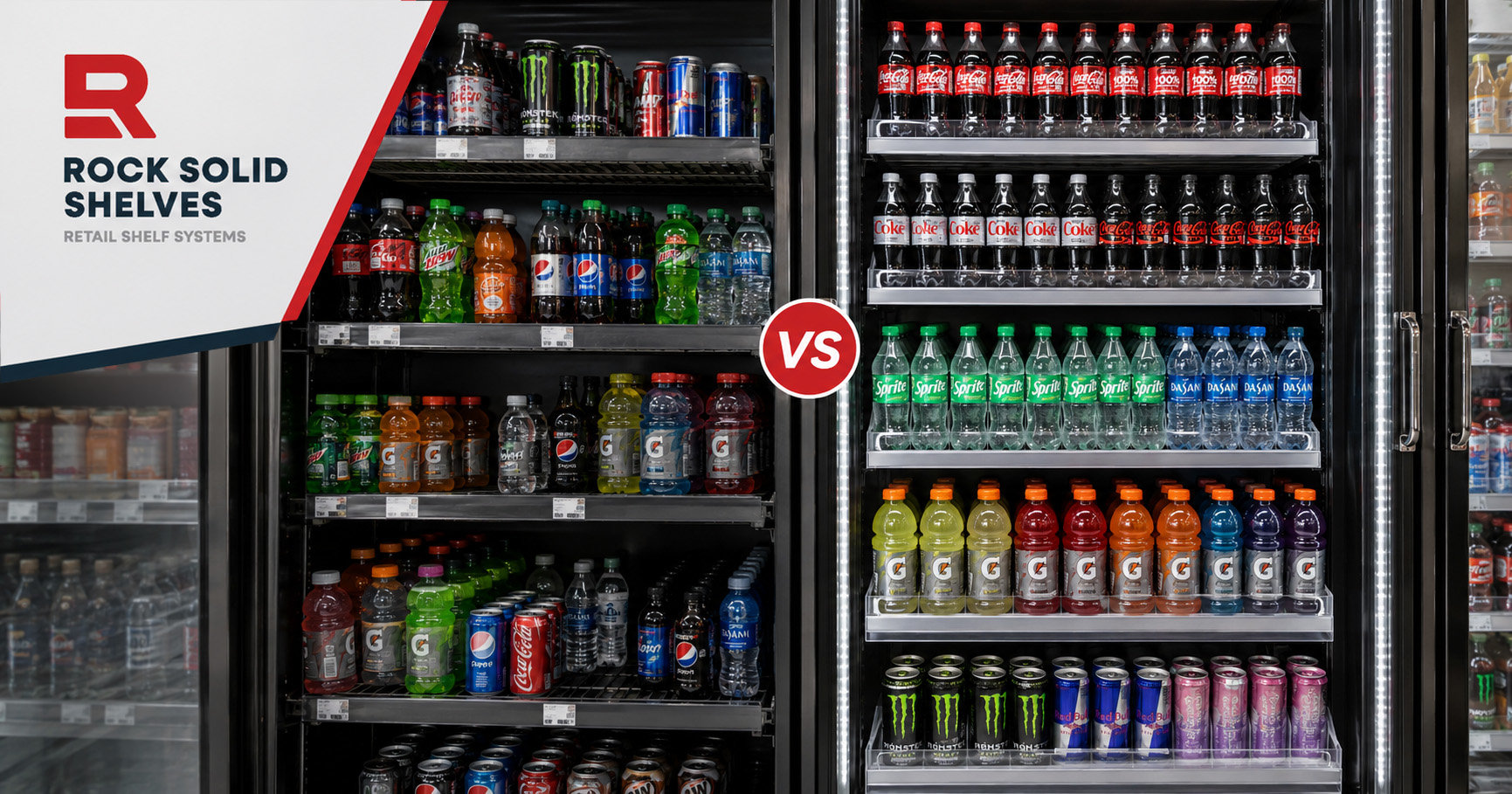
Static shelves develop gaps as products are removed. These gaps make coolers look under-stocked, even when total inventory is adequate. Shoppers who see gaps are more likely to move on or perceive lower product quality.
Gravity feed shelves remain full-looking until the last unit in a lane is removed. There are no gaps between picks because the product advances continuously. The visual presentation of the cooler stays consistent throughout the selling day without any staff intervention.
Energy Efficiency
Every time a cooler door is held open for manual facing or rotation, the refrigeration system works harder to recover temperature. Static shelving requires multiple door-open events per shift for fronting and rotation. Gravity feed shelving reduces the frequency and duration of door-open events because restocking is faster and fronting is automatic.
Installation and Retrofit Compatibility
Static shelving is typically already in place in most convenience store cooler setups. Gravity feed systems like FlexRoller are designed to retrofit into existing cooler rack frames. The installation does not require replacing refrigeration equipment, making the transition from static to gravity feed more practical than many operators expect.
Upfront Cost vs Total Cost
Static shelving has a lower upfront cost. Gravity feed systems require a higher initial investment, but the labor savings, reduced waste from expired product, and improved sales performance significantly change the total cost picture over time. Operators who calculate the total cost of ownership rather than the purchase price alone consistently find that gravity feed systems deliver stronger returns.
Which System Is Right for Your Store?
Choose Gravity Feed When
- Your cooler handles high-turn beverage, dairy, or energy drink categories
- Staff time spent on facing and rotation is a consistent operational problem
- You are managing a beer cave or multi-door walk-in cooler
- FIFO compliance for products with expiration dates is a priority
- You want the cooler to look stocked and organized without constant staff attention
Static Shelving May Work If
- You are managing a very small cooler with slow-moving product
- Product categories have no expiration requirements
- Traffic volume is low enough that manual fronting takes minimal staff time
For most convenience store operators running a competitive cooler program, those conditions rarely apply. The cooler is a primary revenue driver, and the labor cost of managing it manually accumulates faster than most operators track.
Explore beverage cooler rack solutions to see how FlexRoller gravity feed systems perform in active convenience store environments.
| Ready to See the Difference Side by Side? Book a Live or Virtual Demo |
Frequently Asked Questions
Is gravity-feed shelving worth the cost compared to static shelving?
For most convenience store cooler environments, yes. The labor savings from eliminating manual fronting and rotation, combined with reduced product waste and improved shelf presentation, typically deliver a positive return within a short period.
Can gravity feed shelving be installed in an existing cooler rack?
Yes. FlexRoller systems from Rock Solid Shelves are engineered for retrofit installation in standard cooler rack frames. You do not need to replace your refrigeration units.
Does gravity feed shelving work for canned beverages as well as bottles?
Yes. Rock Solid Shelves offers configurations including CanRoller channels specifically sized for canned products alongside bottle and multi-pack configurations.
What is the biggest operational advantage of gravity feed over static shelving?
The elimination of manual fronting. Product advances automatically as units are removed, meaning staff do not need to push, rotate, or reorganize shelf displays between restocks.